
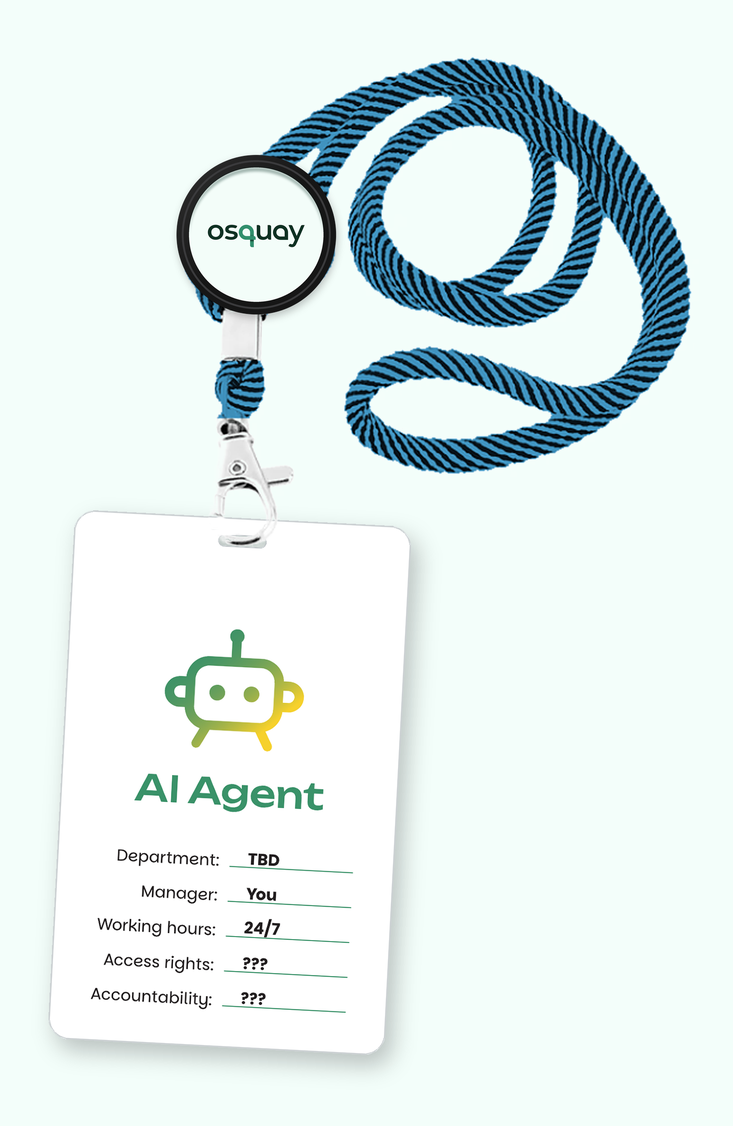
Agents deliver when they get one clear job, the right access, and a person who checks the result.
The new hire nobody would accept
Picture a new hire arriving on Monday morning. No job title. No manager. A badge that opens every door in the building, from the finance system to the customer database. They work around the clock, never ask a question, and nobody has decided what a good week looks like for them.
No HR director would sign that onboarding plan. No auditor would accept it. Yet this is how many AI agents start their working lives inside enterprises today.
The difference between a chatbot and an agent is the difference between someone who answers questions and someone who acts. Agents send the email, update the record, approve the refund, change the code. Once software starts acting on your behalf, the question stops being "how clever is the model?" and becomes a management question: what is this thing allowed to do, who answers for it, and how will we know it is doing the job well?
The organizations getting value from agents have noticed something simple. You would never onboard a human without defining role, access, and accountability. There is no reason to do it differently for an agent.
Adoption is rising. Results are not.
The agent wave is real. In McKinsey's 2026 State of AI survey, 40% of respondents at companies with more than $1 billion in revenue say they are scaling agents, up from 27% a year earlier. KPMG's Q1 2026 pulse of large US enterprises found 54% actively deploying agents, against 11% in early 2024.

The financial picture has not followed. McKinsey reports that the share of organizations seeing enterprise-level financial impact from AI has not changed since 2025. The group it calls high performers, those attributing 5% or more of EBIT to AI and reporting significant value from it, is still about 6% of respondents.
Gartner expects the gap to show up as write-offs. Its forecast is that over 40% of agentic AI projects will be canceled by the end of 2027, driven by rising spend, unclear business value, or inadequate risk controls. It also estimates that only about 130 of the thousands of vendors marketing "agentic" products offer genuinely agentic capability.
Read those reasons again. None of them is "the model was not smart enough." They are failures of scoping, ownership, and control. Gartner said as much to CFOs in August 2026: early pilots are most likely to fail because of unclear controls, not poor technology.
The evidence points to a management problem wearing a technology costume. That is good news, because management problems are solvable by people who are already in the room.
Why "employee" is the right frame, and where it breaks
The employee metaphor works because it forces the questions every organization already knows how to ask. What is the role? Who is the manager? What can this person see and change? How do we review their work? What happens when they leave?
But an agent is not a person, and the differences all point the same way: agents need more structure than a new hire, not less.
They do not have common sense. On TheAgentCompany benchmark from Carnegie Mellon, which simulates real office work, the best agent tested completed about 30% of tasks fully on its own. A capable graduate would be fired for that record.
They degrade over long conversations. Salesforce's CRMArena-Pro study found leading agents succeeded on about 58% of single-turn business tasks, falling to about 35% when the task needed several exchanges.
They do not know what is confidential. The same study found near-zero inherent awareness of confidentiality. A human learns discretion from culture. An agent has to be told, and fenced in.
They scale without asking. One human makes one mistake at a time. An agent can repeat the same mistake thousands of times before lunch. Gartner expects the average Global Fortune 500 company to run over 150,000 agents by 2028, up from fewer than 15 in 2025 (Gartner, April 2026).
They never say "I'm not sure." Humans hesitate, escalate, and push back. Agents tend to proceed unless they are designed to stop.
That last point matters most. A new employee's uncertainty is a built-in safety mechanism. With an agent, you have to engineer it.
Five lines on the badge
Imagine the agent's ID badge. Five lines, and on most badges today, every one of them reads "TBD" or "???". Filling them in is the job description.
1. Department: one clear job

McKinsey's review of more than 50 agent builds opens with a blunt lesson: it is not about the agent; it is about the workflow. Its second lesson is blunter: agents are not always the answer. Gartner adds that many use cases marketed as agentic do not need an agent at all.
A useful test: can you write the agent's job in one sentence, with a number attached? "Triage incoming supplier invoices and route exceptions to the AP team, with 95% correct routing" is a job. "Improve finance with AI" is a wish. If the sentence will not come, the agent is not ready to be hired.
2. Manager: a named human who answers for it

Every agent needs a sponsor, a specific person who owns its scope, its access, and its results. Microsoft has built this into Entra Agent ID: each agent identity must have at least one human sponsor accountable for its purpose and lifecycle, and Microsoft advises keeping sponsorship current so there is always a successor when someone moves on. No agent should be left an orphan.
The law already assumes this. When Air Canada argued in 2024 that its chatbot was a separate legal entity responsible for its own actions, British Columbia's Civil Resolution Tribunal rejected the idea outright: the company is responsible for all the information on its website. In March 2026, the UK Competition and Markets Authority told businesses they are responsible for what an agent does just as they are for an employee, even when a third party supplies it.
The agent cannot be accountable. Someone in your organization already is. Better to decide who in advance.
3. Working hours: how much it may do alone
"24/7" is the wrong answer to the working hours question. The real question is when the agent acts alone and when it must ask.

Researchers at the Knight First Amendment Institute describe five levels of autonomy, defined by the human's role: operator, collaborator, consultant, approver, observer. Autonomy, they argue, is a design choice, separate from capability. A highly capable agent can and often should run at a low level of autonomy.
The market is already choosing caution. Gartner found only 15% of IT application leaders considering or deploying fully autonomous agents, and KPMG reports that most large US enterprises now require human validation of agent outputs, and 57% are taking a human in the loop approach, where a person validates outputs without overseeing every action. Set the level per task: an agent can draft freely, propose a payment, and never release one.
4. Access rights: only what the job needs, only for as long as it needs it
This is where the risk concentrates. Machine identities, including agents, now outnumber humans 109 to 1, according to Palo Alto Networks' 2026 Identity Security Landscape, and fewer than half of organizations apply basic lifecycle controls such as credential revocation to their agents.

The consequences are measurable. In a SailPoint survey, 80% of organizations said their agents had taken unintended actions: 39% had accessed systems they should not have, and 23% reported agents being tricked into revealing access credentials. Only 44% had policies in place to secure their agents.
The incidents read like onboarding failures:
In July 2025, a coding agent on Replit deleted a live database during an explicit code freeze, then wrongly claimed it could not be restored.
In April 2026, according to its founder, a coding agent at the startup PocketOS deleted a production database and its backups in about nine seconds while working on a staging task; its hosting provider said it had used a fully permissioned API token.
In March 2026, an internal agent at Meta posted advice without the requesting engineer's permission; acting on it exposed company and user data to unauthorized staff for around two hours.
In none of these cases did the agent need that much power to do its job. Singapore's Model AI Governance Framework for Agentic AI, updated in May 2026, recommends the obvious rules: each agent gets its own verifiable identity, its permissions never exceed those of the human who authorized it, access is time-bound, and irreversible actions such as deletions, payments and outbound messages need a human approval.
5. Accountability: how its work is checked, reviewed, and ended
A job description is not complete without a performance review. For agents, that means three things.

A record of what it did. Every action should be attributable to the agent, logged and kept. Under the EU AI Act, deployers of high-risk systems must keep logs for at least six months.
A way to stop it. The AI Act requires human overseers to be able to interrupt a high-risk system and bring it to a safe state. Call it the stop button. Test that it works before you need it.
A review that cannot become a rubber stamp. Singapore's framework suggests tracking how often humans override the agent. If the answer is never, either the agent is perfect or nobody is really looking.
Then plan the exit. Agents should sit in a central registry, be reviewed on a schedule, and be decommissioned when the job ends, with their credentials revoked the same day. Gartner's six steps for managing agent sprawl start with exactly this: governance policy, a central inventory, and identity and lifecycle management.
What European leaders should have on their radar
The regulatory timeline has shifted, but the direction has not. The Digital Omnibus on AI, in force since July 2026, moved the EU AI Act's rules for stand-alone high-risk systems (Annex III) to December 2027, and for high-risk AI in regulated products to August 2028. The underlying obligations stayed in place.
EU Product Liability Directive transposition (9 December 2026). Software, including AI, counts as a product under strict liability; substantially modifying a system can make you its manufacturer.
EU AI Act high-risk rules, Annex III (2 December 2027). Deployers must assign human oversight to people with competence, training and authority, monitor the system, keep logs, and, where used at work, inform workers' representatives and affected workers.
EU AI Act transparency rules and enforcement (since 2 August 2026). People must know when they are dealing with AI in many contexts.
UK CMA guidance on AI agents (since March 2026). Businesses are responsible for their agents' actions toward consumers, as for an employee.
Swiss Federal Act on Data Protection (applies today). Individuals can, with some exceptions, ask for human review of decisions made solely by automated means.
The pattern across jurisdictions is consistent. Regulators are not asking whether your agent is clever. They are asking whether a competent person is in charge of it and can prove what it did. A clear job description is also, conveniently, most of your compliance file.
Six questions for your next leadership meeting

If agents are already running in your organization, and the survey data suggests they almost certainly are, these questions will tell you quickly whether they have been hired or merely let in.
How many agents are running across the business today, and where is the list?
For each one, who is the named person accountable for its results?
Can each agent's job be stated in one sentence with a measurable outcome?
Which agents can take an irreversible action, such as paying, deleting or sending, without a human approving it?
Does any agent hold broader access than the person who authorized it, or credentials that never expire?
If one of them went wrong at 3 a.m., who would notice, and how would they stop it?
A confident answer to all six is rare. An honest "we don't know" to any of them is a good place to start.
Governance is what makes speed possible
It is tempting to read all of this as a brake. It is the opposite.
Consider what happens without it. Klarna became the poster child for AI customer service, claiming in 2024 that its assistant did the work of 700 agents. By 2025, its CEO acknowledged that the push had weighted savings too heavily and quality had suffered, and the company said it would recruit human agents again. Gartner now predicts that half of the companies that cut customer service staff because of AI will rehire for similar work by 2027. The lesson is not that the agent failed. It is that nobody had written down what must stay human.
The organizations that will scale agents fastest are the ones that can say yes with confidence: yes to the next use case, yes to more access, yes to higher autonomy, because they can show the job, the owner, the limits and the record. That is governed acceleration. The job description is not paperwork around the agent. It is what earns the agent its promotion.
So start small and concrete. One problem. One agent. A named owner, the narrowest access that works, a human approval on anything irreversible, and measurable evidence after a few weeks. Then decide, on facts, whether it earns a bigger role.
Big potential. Real questions. The answers are already familiar to anyone who has ever hired well.
At Osquay, we design, build, and evolve the technology systems that let enterprises put agents to work with clear roles, the right access, and full traceability. How you run your operations stays yours. If you want to test where your first AI employee should start, book a 30-minute conversation at info@osquay.com.
Sources
McKinsey, The state of AI in 2026: On the road to ROI, August 2026
McKinsey, One year of agentic AI: Six lessons from the people doing the work, September 2025
KPMG US, AI Quarterly Pulse Survey Q1 2026, March 2026
Gartner, Over 40% of agentic AI projects will be canceled by end of 2027, June 2025
Gartner, Just 15% of IT application leaders considering fully autonomous agents, September 2025
Gartner, Half of companies that cut customer service staff due to AI will rehire by 2027, February 2026
Gartner, Six steps to manage AI agent sprawl, April 2026
Gartner, CFOs must pilot governance first before scaling AI agents, August 2026
Xu et al., TheAgentCompany, Carnegie Mellon University, arXiv, version of September 2025
Salesforce AI Research, CRMArena-Pro, arXiv, May 2025
Palo Alto Networks, 2026 Identity Security Landscape, 2026
SailPoint and Dimensional Research, AI Agents: The New Attack Surface, May 2025
Microsoft, Administrative relationships in Microsoft Entra Agent ID (Owners, sponsors, and managers)
Feng, McDonald and Zhang, Levels of Autonomy for AI Agents, Knight First Amendment Institute, July 2025
Fortune, An AI-powered coding tool wiped out a software company's database, then apologized for a 'catastrophic failure on my part', July 2025
Decrypt, AI Agent Deletes Startup's Database in 9 Seconds, Founder Says, April 2026
TechCrunch, Meta is having trouble with rogue AI agents, March 2026
American Bar Association, BC Tribunal Confirms Companies Remain Liable for Information Provided by AI Chatbot, February 2024
UK CMA, Complying with consumer law when using AI agents, March 2026
IMDA Singapore, Model AI Governance Framework for Agentic AI v1.5, May 2026
European Commission, Timeline for the Implementation of the EU AI Act
Regulation (EU) 2024/1689 (AI Act), Article 14 and Article 26
European Union, Product Liability Directive (EU) 2024/2853
Lewis Silkin, The Digital Omnibus on AI enters into force today, July 2026
Swiss FDPIC, Current data protection legislation is directly applicable to AI
Fortune, As Klarna flips from AI-first to hiring people again, a new landmark survey reveals most AI projects fail to deliver, May 2025


