
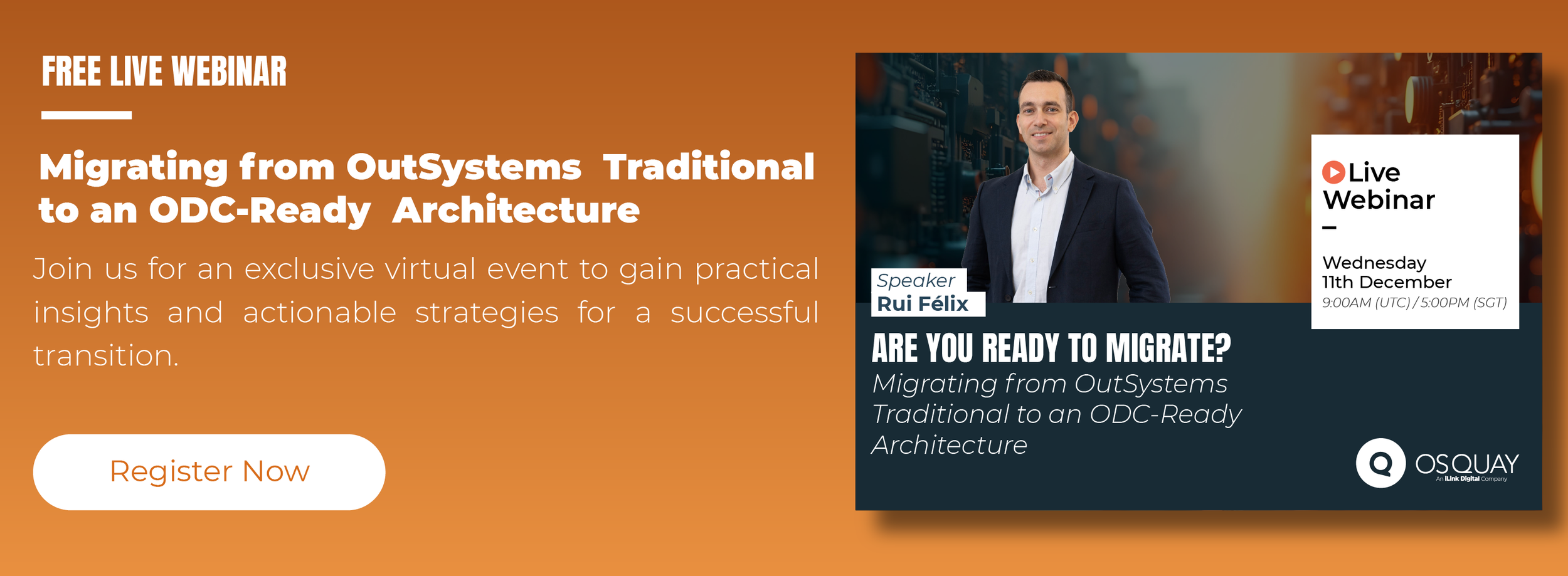
Are You Ready to Migrate?
What to Guarantee Before Transitioning from Traditional to Reactive (and Becoming ODC-Ready)

The shift from OutSystems Traditional Web to Reactive Web is not just a technical upgrade; it’s a strategic move that sets the foundation for the future of your digital factory. As more organizations move towards a domain-driven, ODC-ready architecture, this migration offers distinct advantages—enhancing scalability, delivering faster and more responsive user experiences, and enabling a more modular approach to development.
With Traditional Web reaching its sunset, migrating to Reactive aligns with OutSystems’ innovation path, ensuring your applications stay relevant and optimized. But is your organization ready to take that leap? Before beginning, it’s essential to evaluate your readiness to ensure a smooth, sustainable, and strategically aligned migration. This article will guide you through the considerations critical to ensure your migration is built for long-term success.
Why Migrate Now?
Having worked with OutSystems for many years, I’ve seen firsthand how quickly the platform evolves and how essential it is to stay aligned with its latest frameworks. Early in my career, I worked on numerous Traditional Web applications that served their purpose well. However, as the platform and user expectations advanced, I realized that keeping applications on the Traditional Web could lead to performance, maintenance, and future-readiness limitations.
Now, as OutSystems phases out Traditional Web, migrating to Reactive Web is not just an upgrade—it’s a strategic move to stay at the forefront of OutSystems’ innovation.
Today, migrating to Reactive Web offers clear advantages beyond improved performance. Let’s explore why acting now is crucial for the long-term success and adaptability of your digital factory:
#1—OutSystems Innovation Path: Reactive and Beyond
OutSystems’ roadmap prioritizes Reactive Web and an ODC-ready architecture, focusing on all major updates and performance improvements in these modern frameworks. As the Traditional Web approaches its end, OutSystems will cease support and stop adding new features. By migrating now, your applications will continue to benefit from OutSystems’ latest advancements, keeping them efficient, user-friendly, and future-proof.
#2—Meeting Rising User Expectations
Users expect fast, responsive, and intuitive digital experiences. Reactive Web’s client-side rendering and asynchronous loading make applications significantly quicker and more interactive, meeting these high user expectations. Migrating to Reactive ensures that your applications can provide a seamless, modern user experience that retains engagement and minimizes frustration, which is crucial in a competitive landscape.
#3—Preparing for Domain-Driven and Modular Architecture
Migration to Reactive aligns with a domain-driven approach, breaking down applications into loosely coupled, modular components. This modularity simplifies development and future maintenance, allowing your teams to make updates and improvements more efficiently. A domain-driven, Reactive structure also positions your applications to be ready for OutSystems Developer Cloud when the time comes, making the eventual shift to ODC smoother and more cost-effective.
#4—Increased Scalability and Performance
Reactive Web applications reduce server load by performing most of the UI logic on the client side, which can scale more efficiently as demand grows. Additionally, with fewer round-trips to the server, Reactive applications offer improved performance, especially under high-traffic conditions. Migrating now ensures your digital factory can scale to meet current and future demands without sacrificing performance.
#5—Future-Proofing Your Investment
Migrating from Traditional to Reactive Web helps safeguard the time and resources invested in your digital factory. Delaying the migration only increases the risk of rushing later, potentially under tighter timelines or with less support for the Traditional Web. By transitioning now, your organization gains immediate benefits and reduces future risks and costs associated with a hurried migration.
Essential Steps for a Smooth Migration
With years of experience in technology, I’ve learned that preparation and planning are critical to the success of any migration—not just in OutSystems but across all tech environments. Moving from Traditional to Reactive Web is no exception. This isn’t simply a technical shift; it’s a strategic transition that requires a solid foundation to prevent disruptions and support future growth. In my work, I’ve seen how anticipating potential challenges and securing key elements early on can make all the difference. So, before you dive headfirst into this transformative process, what should you guarantee to ensure a smooth transition?
#1—Assess the Scope of Your Factory
The first step is to take a good look at your current Traditional Web factory. You’re likely dealing with multiple applications, modules, and thousands of blocks and screens actively used across various departments. For example, in a recent migration led by OSQuay, the team had to transition over 1,200 blocks, 700 screens, and 90 modules. This scope demands careful planning and a systematic approach.
Before you begin:
Inventory your factory: Use tools like OutSystems' Discovery or AI Mentor to analyze your current applications, their dependencies, and complexities.
Prioritize critical applications: Start with mission-critical applications like procurement, sales, or accounting, as they demand a seamless transition with zero downtime.
Pro Tip: Create a migration matrix to classify apps by criticality and complexity, prioritizing high-impact apps with low-risk, low-complexity ones following close behind.
#2—Plan for a Dual-Running Environment
One of the most significant challenges in migrating to Reactive is the need to maintain the availability of your applications during the migration. For most organizations, it’s impossible to halt operations while migrating to Reactive. This is where the dual-running environment becomes essential. It ensures that your users will have uninterrupted access to both Traditional and Reactive versions during the transition, reassuring them about the continuity of operations.
You should guarantee:
Minimal disruption to services: Ensure critical applications remain functional during migration by allowing a side-by-side transition between Traditional and Reactive apps.
Fine-grained control over the migration process: Implement a transition approval process for each screen so that selected users can vet and approve the newly migrated Reactive screens before being rolled out to the entire organization.
This approach helps mitigate risks and fosters a culture of continuous user feedback and improvement, making your users feel integral to the migration process.
#3—Automation: Your Secret Weapon
Manually migrating hundreds of modules and thousands of blocks can introduce risks and slow down the process. At OSQuay, we leverage internal processes and tools specifically designed to streamline large-scale migrations, reducing manual errors and accelerating migration efforts.
In a recent project, these tools and processes helped reduce manual labor by 30% and ensured that screens and modules were generated correctly, significantly reducing the risk of human error.
To guarantee efficiency, ensure that:
Automation tools are in place: these tools can automate the creation of screens and modules, accelerating your migration and reducing the workload on your team.
Progress management is transparent: Track what has been migrated, what still needs work, and any exceptions that require manual intervention.
Automation saves time and significantly enhances the quality of your migration.
#4—Ensure Robust Quality Assurance
One of the critical points in any migration is ensuring that nothing breaks in the process. Migrating to Reactive Web isn’t just about shifting code—it’s about ensuring that the new system performs as well as, or better than, the old one. A rigorous quality assurance process is essential to identify any issues early.
Make sure you have:
Automated regression testing: Automated tests can help compare the performance and behavior of your new Reactive apps with their Traditional counterparts.
A reliable approval process: Allow key users to test transitioned applications per screen, ensuring each module performs as expected before fully migrating.
In a previous migration, OSQuay used automated tests to ensure high reusability of test scripts, allowing for smoother QA processes during the migration of hundreds of screens.
#5—Team Enablement for a Smooth Transition
Even though team enablement isn’t the central focus of your migration, your development team will need to be familiar with OutSystems Reactive best practices. Although automation tools can handle many tasks, manual intervention is sometimes necessary for complex modules. Ensuring your team knows how to manage Reactive Web applications is crucial to a successful migration.
Empower your team: While extensive training may not be necessary, a baseline understanding of the differences between Traditional and Reactive development will help your team handle any issues during the migration.
Enable smooth handoffs: If your team is involved in both Traditional and Reactive environments, ensure they can handle both seamlessly during the dual-running period.
#6—Long-Term Scalability: Get ODC-Ready
Finally, as you migrate from Traditional to Reactive, you should consider becoming ODC-ready. OutSystems Developer Cloud represents the platform’s future, and the migration from Reactive to ODC will be much smoother if your Reactive applications follow best practices from the start.
Ensure your architecture is:
Domain-Driven: Organize applications into loosely coupled domains and adopt suitable code patterns to prepare for future ODC migrations.
Microservice-friendly: Modularize your architecture so that your Reactive applications can seamlessly transition into ODC when the time comes.
“Migrating from OutSystems Traditional to Reactive Web is a strategic transition that requires a solid foundation to prevent disruptions and support future growth.”
Ready to Start Your Journey?
Having guided organizations through the shift from OutSystems Traditional to Reactive Web, I’ve seen how this transformation can set the groundwork for future innovation and resilience. A migration of this scale has its complexities, but it can catalyze growth with thoughtful planning, the right tools, and a strategic approach. For teams ready to move forward, this isn’t just a technical step—it’s a strategic investment in a future-ready digital factory. If your organization is prepared to embrace the journey, the rewards will be well worth the effort. Are you ready to make it happen?
Like this article? Share it:


