

The problem is rarely the idea. It is everything that happens between the idea and the evidence.
I have spent enough time around innovation programs to notice something uncomfortable. The organizations that fail at innovation are almost never short of ideas. They have workshops and hackathons full of them. Backlogs full of them. What they lack is a reliable way to find out, quickly and cheaply, which ideas are worth building.
That gap, between having an idea and having evidence, is where most innovation quietly dies. Not in a dramatic failure. In a slow stall.
The numbers bear this out. Depending on which study you read, somewhere between 70% and 90% of digital transformation initiatives fail to meet their objectives, a figure that has stayed stubbornly consistent for over a decade despite everything we have learned. Bain & Company, the global consulting firm, put the failure rate for business transformations at 88%. Those are not the odds of a rare mistake. They are the base rate. And the waste is real: failed transformations are estimated to cost organizations an average of 12% of annual revenue in wasted investment and missed opportunity.
So, it is worth being precise about how, exactly, innovation fails. In my experience it is not one failure. It is a handful of recurring ones, and they fall into three groups. Some ideas never begin, others begin badly, and some run their course but never conclude. Here are the six patterns I see most often.
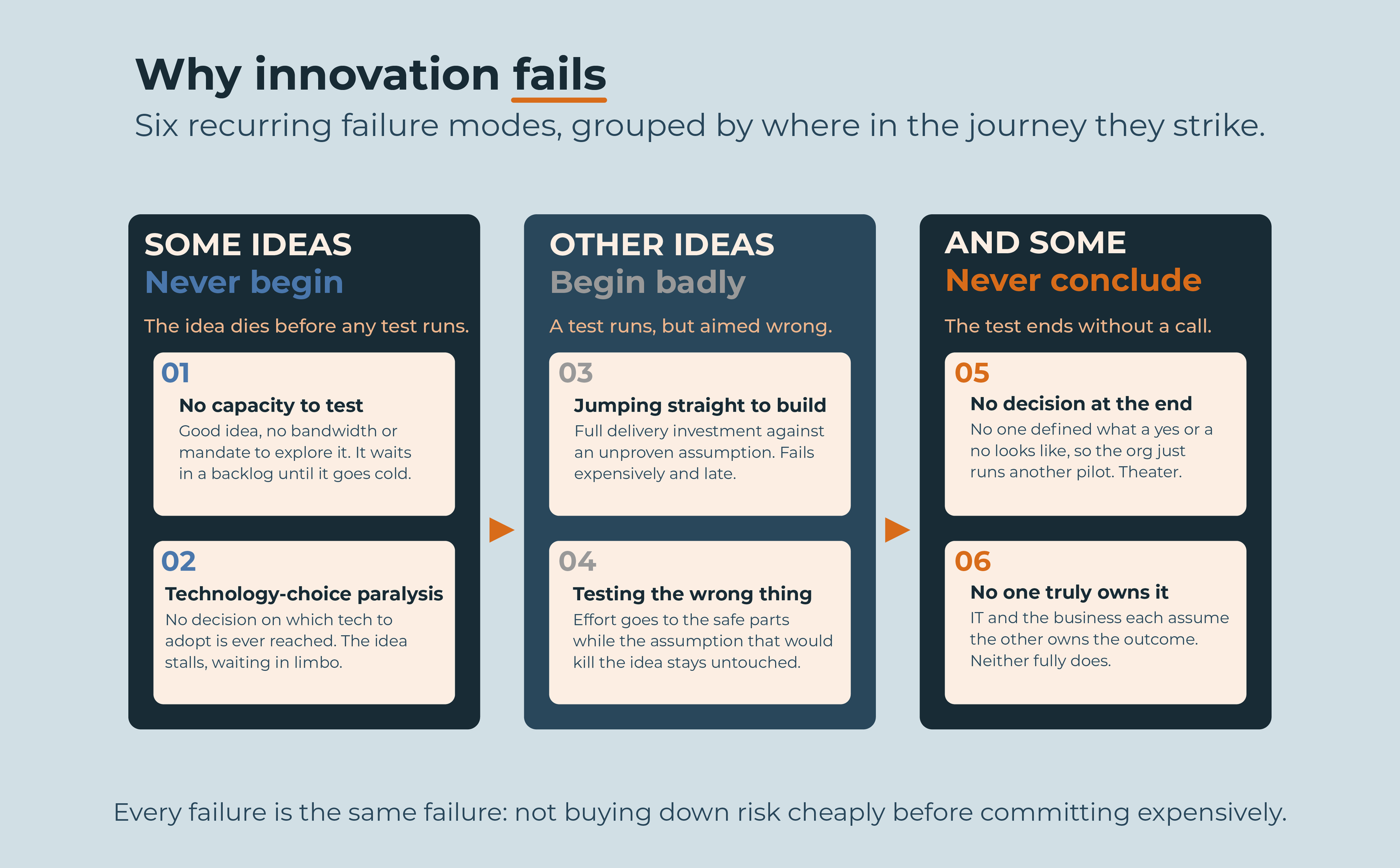
1. There is no capacity to test
The most common failure is the least dramatic. A good idea arrives, everyone agrees it has potential, and then nothing happens. Not because anyone rejected it, but because no one had the bandwidth, the environment, or the mandate to explore it. The team is fully committed to running the business. There is no slack to run an experiment.
So the idea goes into a backlog, where it waits. And ideas do not age well in backlogs. By the time capacity frees up, the market has moved, the sponsor has changed roles, or the enthusiasm has drained away. The idea was never tested. It was simply outlived.
2. The team jumps straight to building
The opposite failure is just as expensive. An idea generates enough excitement that the organization commits to building the whole thing before anyone has validated the assumption underneath it.
This is the seductive one, because it feels like progress. Real budget, a real team, a real roadmap. But full delivery investment against an unproven assumption is not momentum. It is exposure. When the assumption turns out to be wrong, and often it does, the failure is not cheap and early. It is expensive and late, discovered only after the money is spent and the credibility is committed.
Nowhere is this clearer right now than in AI. Gartner predicted that at least 30% of generative AI projects would be abandoned after the proof-of-concept stage, undone by poor data quality, unclear business value, or costs that only became visible once the thing was half-built. These were not bad ideas. They were ideas that skipped the cheap questions and went straight to the expensive ones. Sometimes there is not enough courage to admit the idea was wrong, because so much money has already been spent.
3. Technology-choice paralysis
This one deserves more attention than it gets, because it disguises itself as diligence.
The idea is sound. The appetite is there. But the organization cannot agree on which technology to adopt to pursue it. One group favors one platform, another prefers a different stack, someone wants to wait for the enterprise architecture decision that is always six months away. So the debate continues. More options are evaluated. More comparison matrices are built. And the idea sits in limbo, waiting for a decision that never quite arrives.
I have watched this happen, and the pattern is remarkably consistent. One manufacturing company spent nine months evaluating ERP systems, only to arrive back at their original shortlist, having lost roughly three-quarters of the potential benefit to the delay. The analysis was not the problem. The inability to conclude it was.
The unmade decision becomes the blocker. And here is what makes it so avoidable: you do not need to settle the long-term technology question in order to test an idea. Those are two different decisions. The durable platform choice can wait for evidence. The test cannot. The way out is to be technology-pragmatic, to pick what the test needs in order to prove or disprove the assumption, run it, and let the results inform the lasting choice later. A test is not a marriage. Treating it like one is how ideas die of indecision.

4. The organization tests the wrong thing
Sometimes an idea does get tested, and effort still goes to waste, because the test was aimed at the wrong risk.
Teams polish the interface when the real question was whether the data even exists. They perfect a prototype’s features when the assumption that would actually kill the idea, the one about adoption, or cost, or feasibility, goes untouched. A great deal of energy gets spent proving the parts that were never in doubt, while the genuinely risky assumption sits quietly unexamined until production exposes it.
A test that does not target your biggest unknown is not validation. It is reassurance. And reassurance is a poor thing to build a business case on.
5. There is no decision at the end
This is the most disheartening one, because so much has already gone right by the time it fails.
A pilot runs. It produces something. People saw it work. And then, nothing. No one defined in advance what a “yes” would look like, or a “no.” So the result lands in an ambiguous middle, and the organization does what organizations do with ambiguity: it runs another pilot. The initiative becomes permanently promising and never conclusive. Innovation theater, expensive and endless.
A test without a decision threshold agreed beforehand is not an experiment. It is an activity. The entire value of testing is that it ends in a call, one way or the other.
6. No one truly owns it
Underneath several of these failures sits a question of sponsorship. Innovation stalls when IT builds something the business never asked for, or when the business asks for something without the technical grounding to shape it. Each assumes the other owns the outcome. Neither fully does.
The ideas that survive tend to have a real business sponsor, someone accountable for the outcome, not just the output. Someone who can say what success means in business terms and who has a stake in reaching it. Without that, even a technically successful pilot has nowhere to land, because no one owns the decision to scale it. This is not incidental. Research consistently finds that treating innovation as a technology problem, rather than a business one, is among the most reliable predictors of failure.
The reframe: fail small, then commit with evidence
Read back through those six failures and a theme emerges. Every one of them is a failure to buy down risk cheaply before committing expensively.
The goal was never to avoid failure altogether. In innovation, a fast, cheap “no” is a success. It saves the money and the months that a slow, expensive “no” would have taken. What separates organizations that innovate well from those that stall is not better ideas or bolder bets. It is the discipline to test the riskiest assumption first, at the smallest possible scale, and to let evidence, not enthusiasm and not indecision, drive the decision to build.
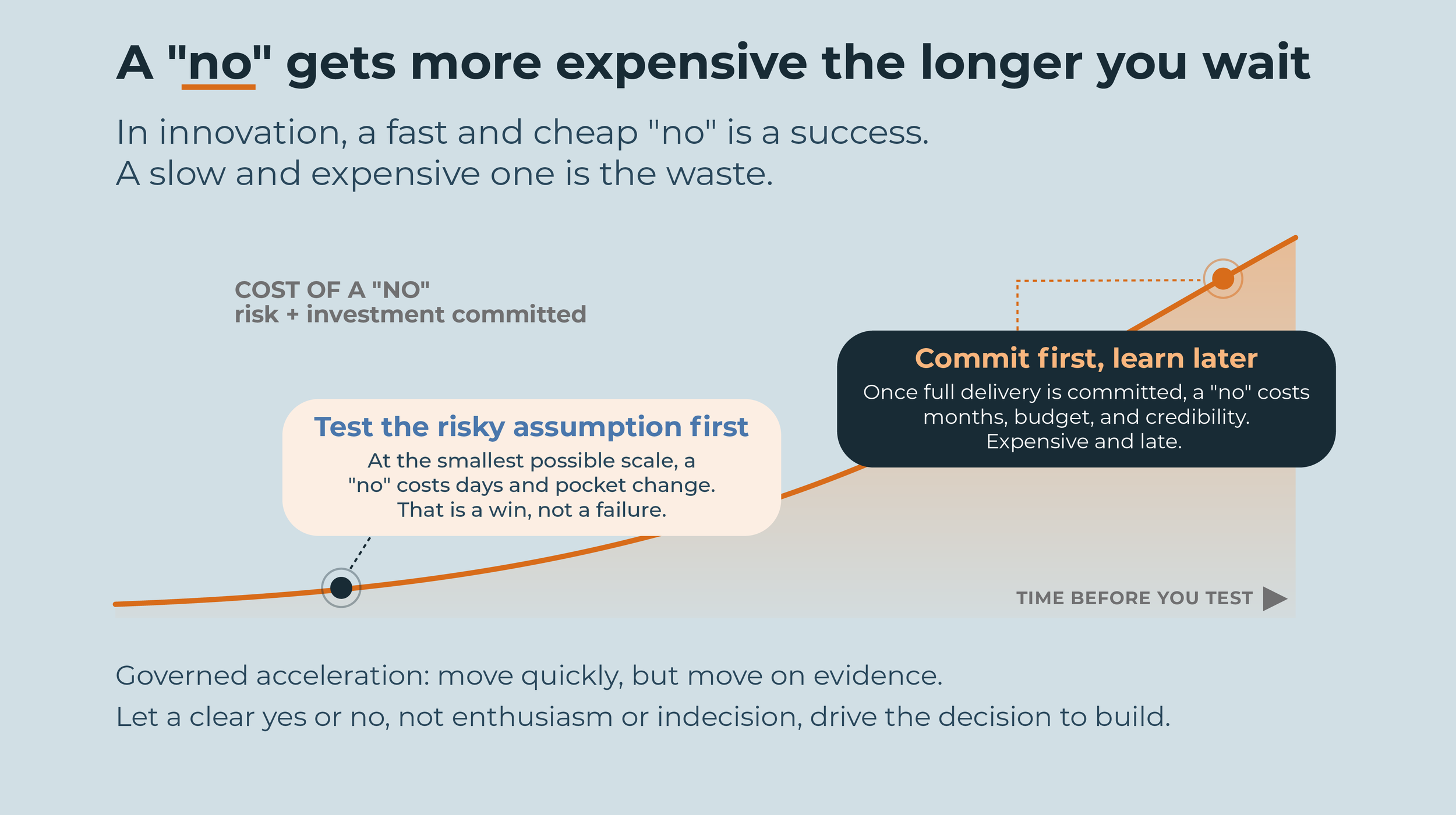
That is what governed acceleration means in practice. Move quickly, but move on evidence. Choose technology pragmatically for the question in front of you. Define what a yes and a no look like before you start. Give the idea a business owner. And run the cheapest test that could kill it before you spend anything you would regret.
Most innovation does not fail because the idea was bad. It fails because the organization never built a reliable, low-cost way to find out. That is a solvable problem. It is, in fact, the whole point of an innovation lab: a place to explore, prototype, and validate fast, using the right technology for the job, so that the ideas worth building can be told apart from the ones that only sounded good in the room.
The ideas are not the scarce resource. The evidence is.
If you're looking to validate ideas before committing real budget to them, you can explore how we approach the Innovation Lab here.


