

Welcome to OSQuay’s Knowledge Center.
A place to find articles, tutorials, how-tos, and more.

AI + OutSystems ODC: A New Operational Model for Modern Digital Delivery
Discover how organizations are transforming operations by integrating AI as a foundational element with OutSystems Developer Cloud. The article examines the evolution of AI Agents, their role in streamlining workflows, ensuring governance, and striking the right balance between automation and human oversight for sustainable business success.

Are You Ready to Migrate?
Wondering if it’s time to migrate from OutSystems Traditional Web to Reactive Web? As OutSystems phases out Traditional Web, moving to Reactive is essential for scalability, performance, and future readiness. This article covers why migrating now is critical, along with the crucial steps—like adopting a domain-driven, ODC-ready architecture and leveraging automation—to ensure a smooth, successful transition for your digital factory.

Transforming Legacy Systems: The Imperative
Legacy systems can quickly hinder innovation and efficiency. Many organizations face outdated systems that drain IT budgets and hamper competitiveness. This article discusses how modernizing your legacy systems can improve data flow, reduce maintenance expenses, and enhance scalability and security.

Handling Null Values in OutSystems REST APIs: Practical Solutions and Best Practices
In this article, OutSystems developers will learn valuable strategies for managing null values in REST APIs. It offers practical solutions using the JSON Null Utils forge component to differentiate fields with values from those without. It also covers techniques for receiving and sending data, setting default values, and using auxiliary boolean fields to handle nulls. With detailed examples and configurations, you will learn to seamlessly integrate OutSystems applications with external systems.

Streamline your data: How to Integrate Google Sheets with OutSystems Applications
This article provides a step-by-step guide on integrating Google Sheets with OutSystems applications for streamlined data management. Learn how to set up your environment, retrieve data from Google Sheets, and display it on your app screens. The guide covers setting up the Google Sheets Rest API, obtaining tokens via the Google API Token helper, and configuring the Google API Service Account.

Crafting Custom Logging & Change Tracking in OutSystems — Part 2: The UI Layer and Use Cases
Continuing our exploration into custom logging and change tracking in OutSystems, this article delves into the UI Layer and use case patterns. It thoroughly examines interface enhancement techniques and the practical implementation of use case patterns. Aimed at developers, the content is focused on the practical application of these patterns designed to integrate seamlessly into any OutSystems application.
Crafting Custom Logging & Change Tracking in OutSystems — Part 1: The Core
Discover the art of custom logging and change tracking in OutSystems with our latest article. This first part of a two-part series dives deep into the core concepts of developing bespoke logging and tracking solutions. Learn how to lay the groundwork for an effective, reusable, and adaptable system tailored to fit the unique demands of your OutSystems applications.

Unlock Real-Time Data Updates in OutSystems: A Quick How-To Using WebSocket Connections
This concise guide walks you through connecting to a Streaming Service that uses WebSockets to push live data. So, let's dive in and learn how to harness the power of real-time data updates in OutSystems effortlessly!

Getting Started with Multi-Tenancy on OutSystems
Multi-tenancy is a vital feature on the OutSystems platform that enables the isolation of data, configurations, and users between tenants. This feature allows the delivery of the same software for multiple customers while ensuring they cannot access each other's data at any moment.
This article will delve into the details of multi-tenancy and how to set it up.

Concepts for BIG OutSystems Projects (Part III)
This series is a compilation of challenges, approaches, and solutions that were part of our path as OutSystems Developers throughout different projects. This third part will go over Feedback Messages.

OutSystems App Development Best Practices Using the 3 Layer Architecture Canvas
Architecture Best Practices are the foundation stones of our applications. They provide us with a solid infrastructure to develop on and ensure we deliver a reliable solution that's easy to maintain and has the flexibility to scale and evolve.
Concepts for BIG OutSystems Projects (Part II)
This series is a compilation of challenges, approaches, and solutions that were part of our path as OutSystems Developers throughout different projects. This first part will go over Time zones, Bionic Finger, and Naming Conventions.
Concepts for BIG OutSystems Projects (Part i)
This series is a compilation of challenges, approaches, and solutions that were part of our path as OutSystems Developers throughout different projects. This first part will go over Time zones, Bionic Finger, and Naming Conventions.
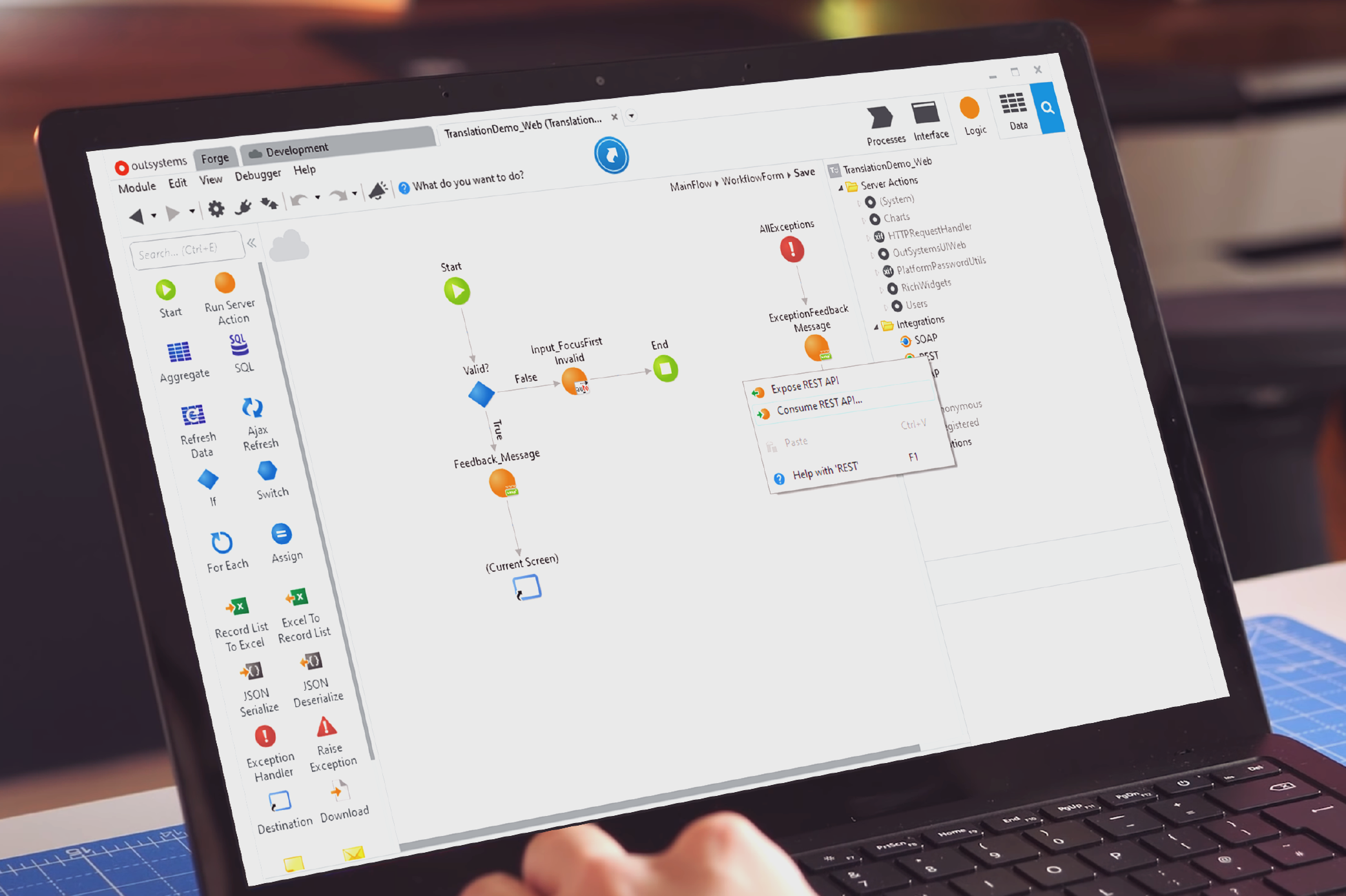
A Closer Look at REST APIs on the OutSystems platform
In this article, we’ll explore what REST API Web Services are and why they are important. We will also explore why they are widely used on the OutSystems Platform, what precautions to take while using them, and some suggestions.